
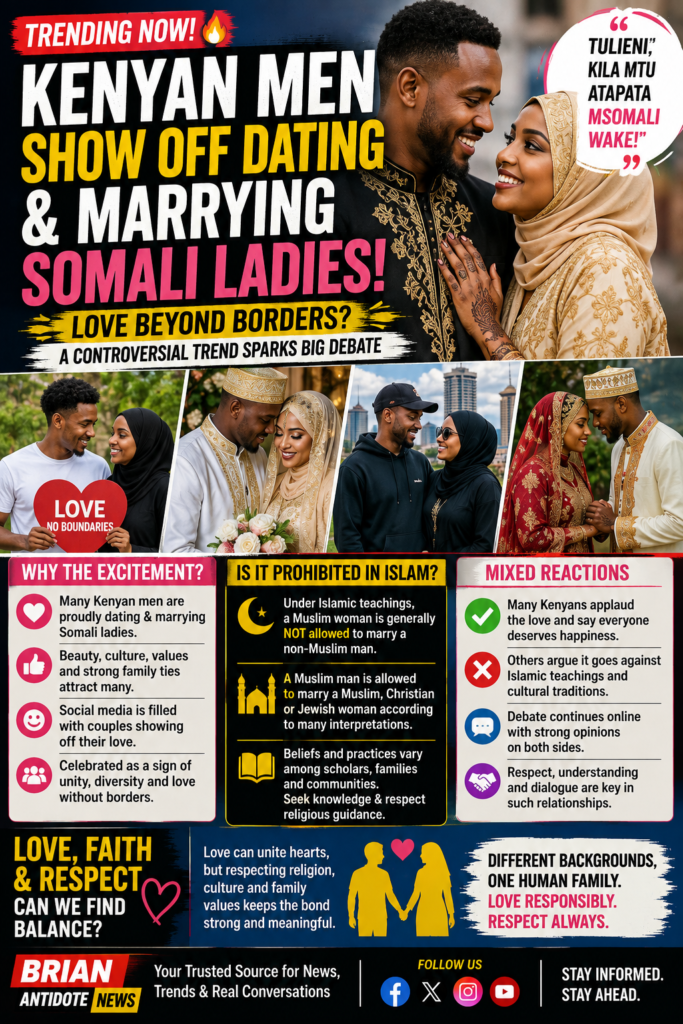


Relationships between Kenyan men and Somali women have become a trending topic on social media, with many users sharing photos, videos, and humorous posts celebrating marriages and relationships across communities. Some have jokingly used the phrase “Tulieni, kila mtu atapata Msomali wake” (“Relax, everyone will get their Somali partner”) as the trend gained attention online.
The discussions have also sparked debate about religion and culture, with some users claiming that Islam prohibits Muslim women from marrying Christian men. Under traditional Islamic jurisprudence, a Muslim woman is generally not permitted to marry a non-Muslim man, while a Muslim man is traditionally permitted to marry a Muslim woman or, according to many interpretations, a Christian or Jewish woman. However, beliefs and practices vary among individuals, families, and communities, and some couples choose different paths based on personal convictions or legal frameworks.
Beyond the religious discussion, many Kenyans have welcomed the trend as a reflection of the country’s cultural diversity and the growing acceptance of relationships across ethnic and religious backgrounds. Others have emphasized the importance of respecting both religious beliefs and personal choices when discussing interfaith marriages.
Legal recognition of marriages depends on the laws of the country where they are celebrated, while religious recognition depends on the teachings and practices of the faith communities involved. As a result, what is accepted under civil law may differ from what is recognized by a particular religious tradition.
The online conversation continues to generate mixed reactions, with supporters celebrating love beyond cultural boundaries and others stressing the importance of observing religious teachings and family traditions.
📌 Stay with Brian Antidote News for timely updates, breaking news, and in-depth analysis on society, culture, and current affairs.